AI Workflow Implementation

Duration

4 months- '26

Team

7 person team (Purdue UXD × Key Lime Interactive)

7 person team

(Purdue UXD Experience Studio × Microsoft)

Project Type

UX Research

My Role

I led the team, drove the process blueprint through multiple iterations, and organized our research findings through affinity diagramming and synthesis.

Context

Key Lime Interactive wanted to figure out how AI could realistically fit into their research workflow. Through employee interviews, a company-wide survey, and concept testing, we identified four AI use cases and mapped exactly where each one belongs across KLI's research process.

Deliverables

A comprehensive use cases report, a process blueprint mapping AI opportunities across KLI's workflow, and use case storyboards and videos illustrating each concept in action.

Impact

Our research and synthesis gave KLI four validated AI use cases along with a research-backed rationale for where AI adds value, where it needs guardrails, and where researcher judgment should stay central.

Problem Space

KLI had already started adopting AI, but usage varied widely across teams and tasks.

We started by surveying employees and mapping KLI's six-phase research process, identifying where each phase relied on manual, repeatable work that AI could plausibly support.

What the survey revealed

Employees were open to using AI, yet held real concerns around accuracy, trust, data privacy, and knowing when it should or shouldn't be used.

What the survey revealed

Employees were open to using AI, yet held real concerns around accuracy, trust, data privacy, and knowing when it should or shouldn't be used.

Going deeper

We synthesized more than 10 scholarly sources on AI in research and service-design workflows. The clearest pattern: AI performs best as a support tool for early-stage, repetitive tasks, and loses trust quickly whenever its reasoning isn't visible or its outputs turn out to be inaccurate.

Going deeper

We synthesized more than 10 scholarly sources on AI in research and service-design workflows. The clearest pattern: AI performs best as a support tool for early-stage, repetitive tasks, and loses trust quickly whenever its reasoning isn't visible or its outputs turn out to be inaccurate.

Discovery

Most employees reported high comfort using AI at work and strong interest in learning more, but adoption was task-dependent, not role-dependent. AI was trusted for drafting and organizing, and far less trusted for synthesis, analysis, and final judgment calls.

Talking directly with Researchers

Researchers already use AI at multiple points in their workflow, but deliberately keep the thinking human.


"I use it to start data analysis, but I do my own as well to compare and see what AI is missing."

Talking directly with Researchers

Researchers already use AI at multiple points in their workflow, but deliberately keep the thinking human.


"I use it to start data analysis, but I do my own as well to compare and see what AI is missing."

Finding Opportunities

We mapped where AI was already active in KLI's workflow, mostly in the analysis phase, and where it remained underused, like the beginning phases.


Across every phase, the same barriers kept surfacing: concerns about output accuracy, the extra time needed to verify AI work, unclear organizational guidelines, and a reluctance to hand over ownership of the final product.

Finding Opportunities

We mapped where AI was already active in KLI's workflow, mostly in the analysis phase, and where it remained underused, like the beginning phases.


Across every phase, the same barriers kept surfacing: concerns about output accuracy, the extra time needed to verify AI work, unclear organizational guidelines, and a reluctance to hand over ownership of the final product.

Concept Testing

Once we had four draft use cases, we ran a second survey with 14 KLI employees to react directly to each concept.

Quote Extraction was the clear favorite.

"Easily the greatest time saver."

Theme Extraction was valued but came with real concern about hallucinated outputs and researchers feeling replaceable.

Research Planning had the most pushback.

"Why are we even here as consultants if a client could just input their needs into AI and get their solution without us?"

Data Visualization was seen as promising in theory but currently slower than doing it by hand.

We used this feedback to refine every use case's scope and guardrails before final delivery.

Once we had four draft use cases, we ran a second survey with 14 KLI employees to react directly to each concept.

Quote Extraction was the clear favorite.

"Easily the greatest time saver."

Theme Extraction was valued but came with real concern about hallucinated outputs and researchers feeling replaceable.

Research Planning had the most pushback.

"Why are we even here as consultants if a client could just input their needs into AI and get their solution without us?"

Data Visualization was seen as promising in theory but currently slower than doing it by hand.

We used this feedback to refine every use case's scope and guardrails before final delivery.

Final Delivery

Theme Extraction

Data Visualization

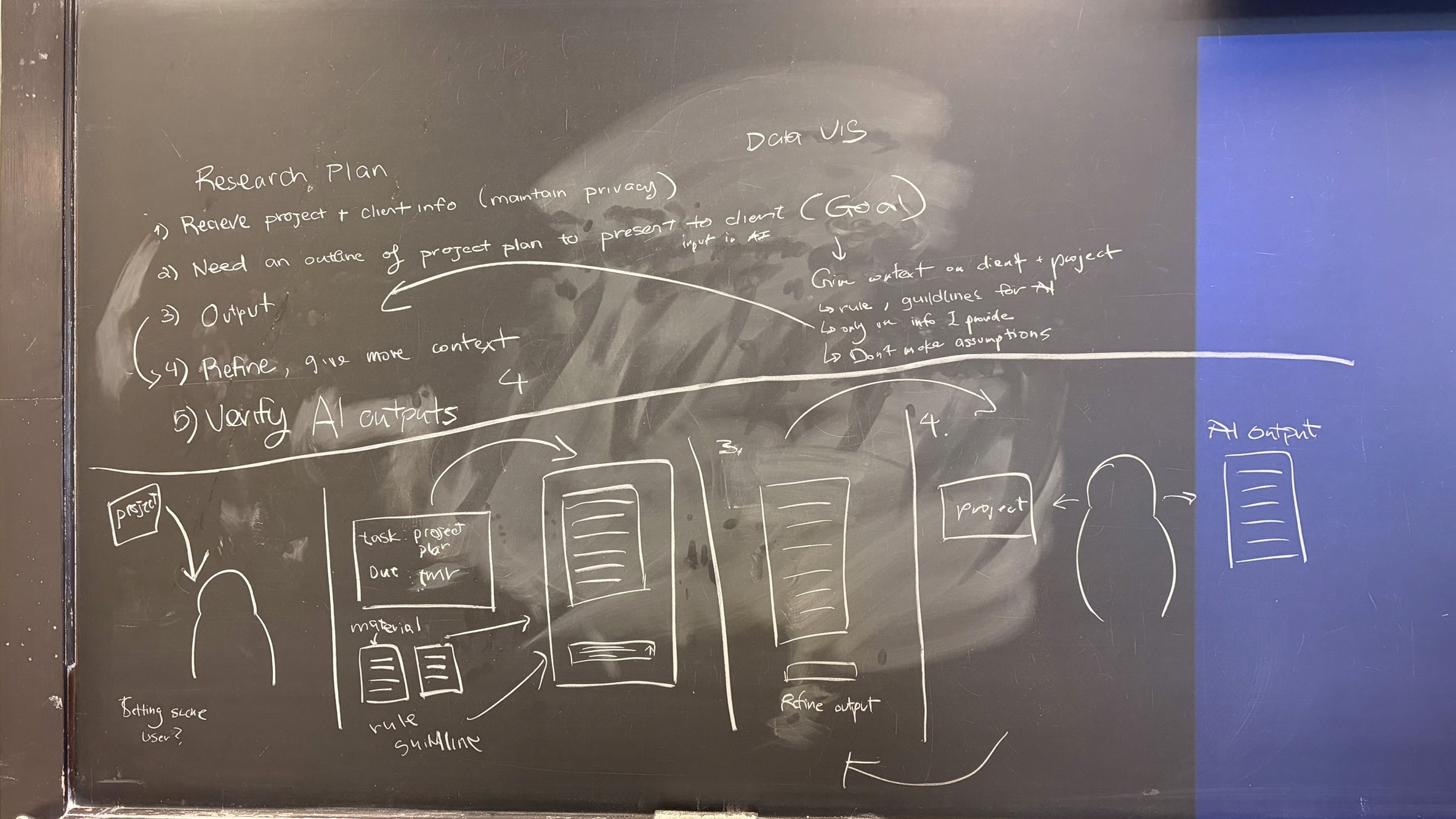
Research Planning

Quote Extraction

Reflection

This project taught me how much primary and secondary research matters, and how important it is to keep going back to that research every time you make a decision instead of relying on assumptions. AI itself was something I was already curious about, so getting to dig into better prompting techniques and ways to reduce hallucinations made the work even more engaging.

Latest Projects

CONTACT

Reach out to start a conversation.

CONTACT

Reach out to start a conversation.

CONTACT

Reach out to start a conversation.